
Rai Breaks Through, Aronimink Delivers, and Woad Keeps England’s Golf Week Rolling
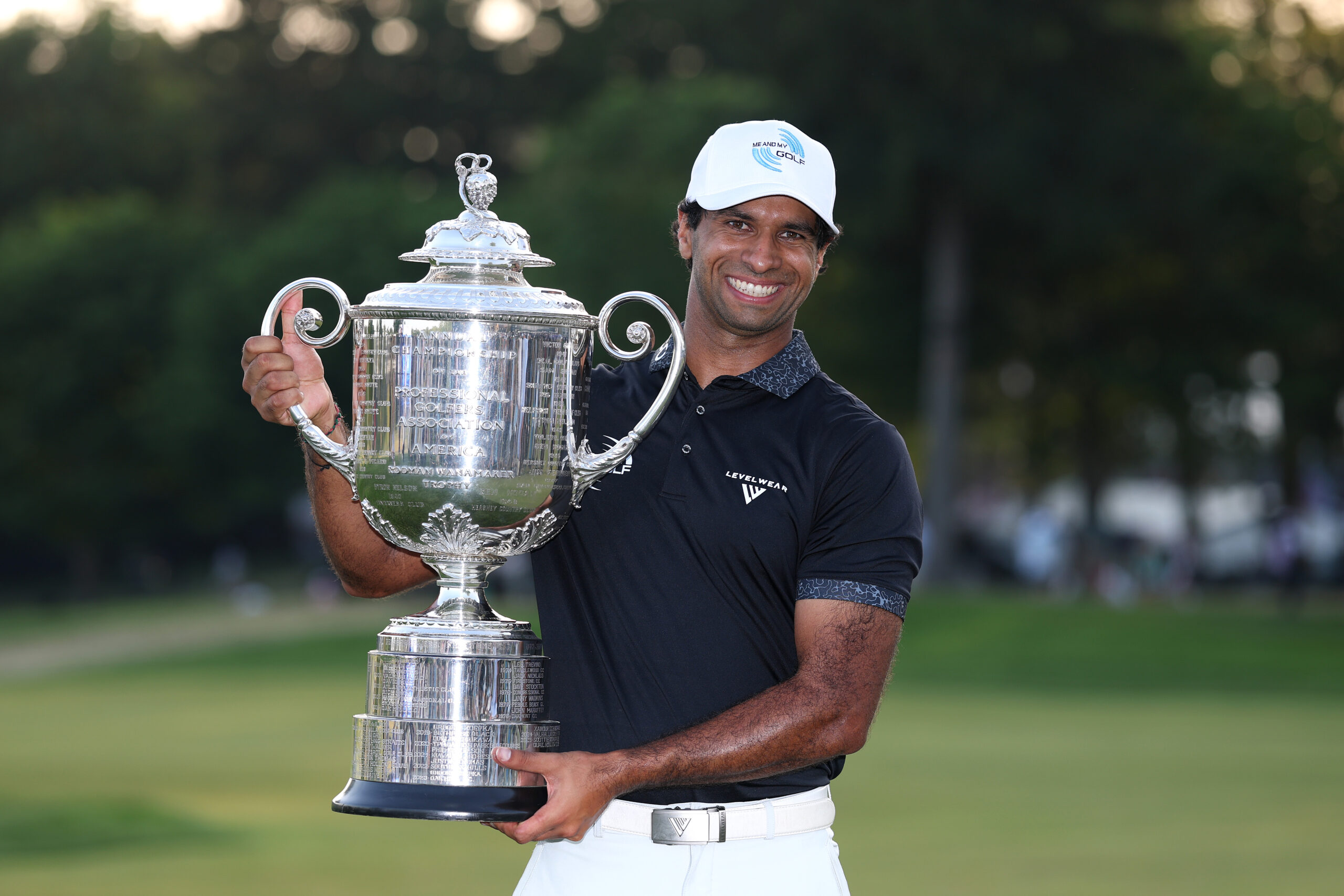
In this week’s “The Starter,” Aaron Rai turns Aronimink into the site of a career-changing major breakthrough, the PGA Championship gets the kind of complete test it deserved and Lottie Woad adds another impressive LPGA Tour victory to what is quickly becoming one of the most interesting young résumés in the women’s game.
The PGA Championship: Rai Turns Aronimink Into His Arrival Party
A Major Win Built On Patience, Precision, and Belief
There are major championship wins that feel inevitable.
This was not one of them.
Aaron Rai did not arrive at Aronimink as the obvious story of the week. He was not the pre-tournament betting favorite. He was not the star most viewers circled before the first tee shot was struck. He was not the player carrying the loudest narrative into the second men’s major of the season.
Then Sunday happened.
Rai closed with a 5-under 65 at Aronimink Golf Club, finished at 9-under, and won the 108th PGA Championship by three shots over Jon Rahm and Alex Smalley. It was his first major championship victory, his second PGA TOUR title, and the kind of performance that can reshape an entire career in one afternoon.
That is what major championships do when they are at their best. They do not simply reward form. They reveal something.
For Rai, they revealed a player with the patience to wait for the week to come to him and the precision to take it when it did.
His final 10 holes were the difference. He played that stretch in 6-under, turning a crowded, tense Sunday into something that suddenly belonged to him. The moment that will live longest was the deep birdie putt on the 17th green, the one that sent him three clear with one hole to play and made the Wanamaker Trophy feel less like a dream and more like his immediate future.
But Rai did not win because of one putt.
He won because he kept answering Aronimink’s questions. He won because he never looked overwhelmed by the size of the moment. He won because a championship that asked for control, discipline, and toughness eventually found a player who had all three.
There is a beautiful simplicity in that.
Rai is easy to root for because his story does not feel manufactured. He carries himself with humility. His game has always looked more careful than flashy, more thoughtful than loud. Even the small details that have followed him for years, from the two gloves to the iron covers, speak to a player who respects the game, respects his equipment, and understands that nothing in golf should be taken for granted.
On Sunday, that respect turned into history.
Rai became the first Englishman since Jim Barnes in 1919 to win the PGA Championship. That gap is almost hard to process. England has produced major champions, Ryder Cup anchors, world-class ball-strikers, and legends of the professional game, but the Wanamaker Trophy had remained out of reach for more than a century.
Now Rai’s name is attached to it.
That is not just a career highlight. That is a legacy marker.
Aronimink Reminded Everyone What A Major Test Should Be
The PGA Championship needs places like Aronimink.
That is not a knock on every other venue. It is a compliment to what this week became.
Aronimink did not feel gimmicky. It did not feel tricked up. It did not feel like a course that relied on a single defense. It asked for everything. Driving mattered. Approach play mattered. Distance control mattered. Putting mattered. Nerve mattered. Patience mattered.
That is what a complete test looks like.
For four days, the course gave players enough room to make birdies but never enough room to relax. It created scoring chances without handing them out freely. It punished misses without turning the event into a survival contest. It allowed movement on the leaderboard without letting the championship lose its shape.
That balance is not easy.
Modern major championship golf can drift too far in either direction. Sometimes setups become so severe that creativity disappears, and the tournament becomes mostly about avoiding disaster. Other times, the best players in the world turn a course into a chase for 25-under, and the architecture becomes more of a backdrop than a participant.
Aronimink sat in a better place.
It had teeth, but it also had rhythm. It could be attacked, but only by players who were in position. It rewarded courage, but only when courage was paired with execution. That is why Rai’s final-round 65 meant so much. It was not a number produced by a defenseless course. It was a round that had to be earned.
The PGA Championship had not been at Aronimink since 1962.
That is far too long.
A venue like this should not disappear from the major championship rotation for six decades. This week was a reminder that some American golf courses do not need reinvention to matter. They simply need another chance to show what they are.
Aronimink did that.
The hope now should be obvious. Do not make the game wait another 64 years before this place gets another major championship stage.
The Chase Gave Sunday Its Weight
Rai’s victory will be the lasting headline, but the week worked because so many players had a chance to make it theirs.
Alex Smalley entered Sunday with the lead and left with a runner-up finish that should still change the way he sees himself. Holding a 54-hole lead in a major is different from contending in a regular TOUR stop. It is heavier. Everything is louder. Every miss feels magnified. Every decision carries extra weight.
Smalley did not win, but he did something important. He proved he could handle the deep end of a major championship leaderboard.
Rahm’s runner-up finish added a familiar major presence to the final board. Even when he is not at his absolute best, Rahm has a way of making the back nine feel bigger. He brings gravity to a tournament. His name near the top changes the room.
Justin Thomas, Ludvig Åberg, and Matthias Schmid finished one shot behind Rahm and Smalley. Rory McIlroy, Xander Schauffele, and Cameron Smith were close enough to keep the board feeling dangerous. Kurt Kitayama gave the final round one of its great early jolts with a 63 that sent him flying up the leaderboard.
That is why Sunday had such good tension. It was not one player trying to protect a huge lead. It was a major championship full of movement, possibilities, and pressure points.
There were proven major champions. There were rising stars. There were players trying to break through. There were players trying to restart something. There were players trying to turn a good week into a career week.
Rai beat all of them.
That matters.
A first major title always changes a player’s biography, but the quality of the chase matters, too. Rai did not slip through a weak board. He outlasted a leaderboard with weight, talent, and pedigree. That makes the victory feel even more complete.
A Quiet Champion For A Loud Time In Golf
Golf is not always simple right now.
The professional game has spent years tangled in conversations about money, structure, loyalty, power, and future direction. Sometimes those conversations are necessary. Sometimes they are exhausting. Either way, they can make the game feel heavier than the shots themselves.
That is part of why Rai’s win landed so well.
It felt clean.
A respected player, widely liked by peers and admired for how he carries himself, played the round of his life on one of the game’s biggest stages. He did it on a course that demanded great golf. He did it against a leaderboard filled with names that could have taken the trophy away. He did it without needing to be the loudest person in the story.
There is something refreshing about that.
Rai’s game is not built on intimidation. It is built on repetition, accuracy, discipline, and trust. In a sport often obsessed with speed and power, his win was a reminder that precision still travels. Thoughtfulness still matters. Composure can still beat chaos.
That does not make him old-fashioned. It makes him dangerous.
The best part is that this does not have to be treated as a one-week fairy tale. Rai has been building toward something meaningful. Winning the 2024 Wyndham Championship gave him PGA TOUR validation. Winning the PGA Championship gave him permanence.
Now he is not just Aaron Rai, a solid player.
He is Aaron Rai, the major champion.
That changes everything.
The LPGA Tour: Woad Keeps Building Something Real
Another English Winner Adds To A Big Golf Sunday
The PGA Championship owned the biggest spotlight of the week, but Lottie Woad made sure England’s golf story was not limited to Aronimink.
Woad won the Kroger Queen City Championship at Maketewah Country Club in Cincinnati, finishing at 12-under and holding off Haeran Ryu by two shots. Miyu Yamashita finished third, with Ruoning Yin, Amanda Doherty, Jin Young Ko, Jeeno Thitikul, Nelly Korda, Jennifer Kupcho, and Lydia Ko among the notable names on the first page of the leaderboard.
That is a serious board.
Woad beat it.
This was her second LPGA Tour title, and it added another layer to a rise that continues to feel more substantial by the week. Some young players arrive with attention before they are ready for it. Others continue to prove that the attention is justified.
Woad is moving closer to the second category.
What stands out is not just the scoring. It is the presence. She plays with a calm that does not feel forced. She has enough talent to win, but the larger question for young players is always whether they can keep doing it when the expectations change.
This week was another positive answer.
There was also a nice symmetry to the Sunday. Rai won the PGA Championship. Woad won on the LPGA Tour. Two English winners, two very different stages and two players showing that patience, poise and competitive clarity still count for plenty.
Woad’s win does not need to be inflated beyond what it was. It was a strong LPGA victory, not a major championship. But it does matter. The LPGA continues to produce young stars who make the tour deeper, more global and more compelling. Woad is becoming one of those players.
And if this keeps going, her weeks will stop feeling like promising signs and start feeling like part of a much bigger pattern.
The Closing Thought
This week in golf worked because it gave us two versions of arrival.
At Aronimink, Aaron Rai arrived as a major champion. Not with noise. Not with bravado. Not with the kind of larger-than-life performance that overwhelms the field from the start. He arrived through discipline, control and a Sunday finish that turned opportunity into history.
At Maketewah, Lottie Woad kept arriving as one of the LPGA’s young players worth watching closely. Another win. Another strong field beaten. Another reason to believe her ceiling is still moving.
But the larger takeaway belongs to the PGA Championship.
Aronimink gave the event exactly what it needed. A great course. A demanding test. A packed leaderboard. A worthy champion. A Sunday that kept changing until one player finally separated himself.
That is major championship golf.
It should feel hard. It should feel fair. It should identify more than one skill. It should make players uncomfortable without making the setup the entire story. It should give the winner something he has to earn.
Aaron Rai earned it.
Aronimink delivered it.
And golf was better for both.