
“I Play Better When More Eyes Are on Me”: Wyatt Cullen’s Late Surge Turning Heads Ahead of 2026 NHL Draft
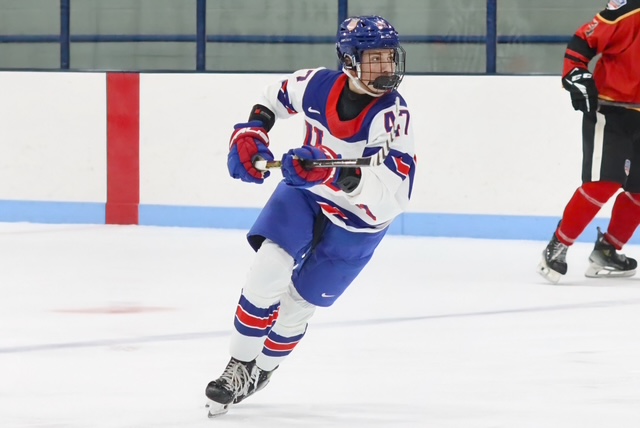
Wyatt Cullen’s draft year could have quietly slipped away before it ever had the chance to take shape.
Instead, it has turned into one of the most compelling rise stories in the 2026 NHL Draft class.
After missing the opening months of the season with a significant injury, Cullen didn’t just return to form. He rebuilt his game, grew into his body, and delivered his best hockey when it mattered most. By the time he stepped onto the ice at the U-18 World Championships with Team USA, he was no longer chasing relevance. He was commanding it.
Now listed at roughly 6-foot-1 and around 180 pounds after a major growth spurt over the past year, the U.S. National Team Development Program forward has paired physical development with a sharp upward performance curve. His production with the NTDP this season, where he recorded 16 goals and 45 points in 40 games for the U-18s, only tells part of the story.
But his breakout performance at the U-18 World Championships, which saw him record three goals and nine points in 5 games for Team USA, confirmed what scouts had already begun to see down the stretch.
Cullen is not just trending upward. He is accelerating.
A Season That Began With Uncertainty
Cullen entered the year believing he was ready to take a major step.
After what he described as a huge offseason, he felt stronger, quicker, and more dangerous offensively than he had ever been before. Then, on the very first day of training camp, everything stopped.
“I injured it on a skating test,” Cullen said. “That put me out three months.”
The injury was significant. Cullen later explained that he had pulled bone off his hip flexor, an injury severe enough to derail much of the early portion of his draft year. For a player already trying to establish himself in a loaded draft class, the timing could not have been worse.
“It was obviously a tough setback,” he said. “I didn’t really know what the year was going to look like.”
What followed became the defining stretch of his season.
Instead of focusing solely on getting back onto the ice, Cullen completely changed his day-to-day approach to preparation. Mobility work, stretching, recovery, nutrition, and body maintenance became central parts of his routine. His father, longtime NHL forward Matt Cullen, even moved to Michigan during the season to help guide him through the process.
“He made every meal for me, meal prepped every day,” Cullen said. “We’d do video every Monday after games. He helped me so much.”
The time away from the ice forced Cullen to mature quickly. He admits there were moments of doubt, especially early in the recovery process, but the adversity ultimately reshaped his confidence.
“I think going through it gave me more confidence in myself,” he said. “It helped me grow in areas I never thought I could.”
That growth was literal as much as it was mental.
Over the past year, Cullen experienced a massive physical transformation, growing from approximately 5-foot-8 to 6-foot. The added size changed the way he approached the game and dramatically expanded what he could do offensively.
“Last year, I couldn’t really shoot it,” Cullen said. “I was smaller. I put so much work into that this summer, just shooting pucks over and over.”
Suddenly, the skillset scouts had always liked had a different level of projection attached to it.
From Surviving The Season to Driving It
Returning in the middle of a draft year is one thing. Returning while trying to immediately establish yourself among NHL scouts is something entirely different.
Cullen did not have the luxury of easing into the season.
When he returned to the lineup, players like Carter Meyer and Noah Fitzhenry had already helped stabilize the NTDP offense. Cullen needed to find chemistry, regain timing, and prove he could still impact games after months away from competition.
Instead, he quickly became one of the team’s most dangerous players.
“I came back and first game, I was the guy right away,” Cullen said. “My confidence just kind of skyrocketed.”
The adjustment period was not perfectly smooth. Cullen admitted there were setbacks early in his return, including re-aggravating the injury during international play. But once he got through the first month, his game began trending sharply upward.
Every week, he looked faster and stronger. His skating carried more explosiveness. His ability to attack defenders became more assertive. Most importantly, his offensive confidence exploded.
“I just kept getting better every week,” Cullen said. “My game was faster, stronger, and I really peaked at the end.”
That progression is one of the biggest reasons NHL teams have become increasingly fascinated with his profile.
Scouts consistently prioritize players whose trajectories point upward late in the season, especially when those improvements are tied to legitimate physical growth and expanding offensive tools. Cullen checks every one of those boxes.
The player who struggled to consistently generate shots a year ago evolved into a legitimate scoring threat by the end of the season. His added size allowed him to attack through defenders instead of around them, while his skating became more deceptive and dynamic.
“I can attack the game more now,” he said. “I’m bigger, faster, and I can beat guys.”
His skating remains one of the defining traits of his game. Cullen points specifically to his ability to change pace and attack with deception as one of his biggest strengths, something he has modeled after players like Jack Hughes and James Hagens.
“I think one of my biggest strengths is my deceptiveness with my skating,” Cullen said. “Changing pace and beating guys.”
That combination of agility, confidence, and newfound physical maturity gave Cullen a completely different look by the second half of the season. Instead of simply trying to re-establish himself, he became one of the few consistent offensive bright spots on the NTDP roster.
A Breakout on The Biggest Stage
If Cullen’s second half built momentum, the U-18 World Championships confirmed his arrival.
With NHL scouts flooding the tournament and draft discussions intensifying, Cullen delivered the best stretch of hockey of his season. It was the exact kind of performance evaluators remember in the final weeks leading into the draft.
“I think I made the most of my opportunity,” he said. “There were a lot of eyes there and I thought I played pretty well.”
More importantly, he looked comfortable in the spotlight.
One of the recurring themes throughout Cullen’s season has been his ability to elevate in heavily scouted environments. He believes his game naturally rises in bigger moments, something that repeatedly showed up during the final stretch of the year.
“I think every big game this year, I played really well,” Cullen said. “When more eyes are on me, I play better.”
That confidence has become increasingly visible in the way he plays offensively. Cullen describes his best hockey as instinctive and free-flowing, driven by creativity rather than hesitation.
“When I’m at my best, I’m playing free,” he said. “Like it’s pond hockey. Just having fun.”
Scouts have clearly responded to that mentality.
Several public rankings now project Cullen as a first-round prospect after beginning the season much lower on draft lists. The Hockey Writers recently described him as one of the biggest risers in the draft class, while Daily Faceoff highlighted how he consistently saved his best performances for major showcase events.
What makes Cullen’s rise particularly intriguing is that it does not feel finished.
The combination of rapid physical development, improved offensive confidence, and high-end skating gives teams plenty to project moving forward. Add in the habits he developed while battling through injury and the experience of navigating a difficult draft season, and the profile becomes even more compelling.
Cullen is already committed to the University of Minnesota, where he will continue his development next season. But regardless of where he plays next year, his draft stock now carries a completely different level of momentum than it did just a few months ago.
At the beginning of the season, Wyatt Cullen was trying to recover.
By the end of it, he was forcing the hockey world to pay attention and pushing his draft stock into various teams’ top-10 lists for the 2026 NHL Draft.