
“I’ll Go Right Into That Corner”: Adam Valentini Emerging As a 2026 NHL Draft Sleeper
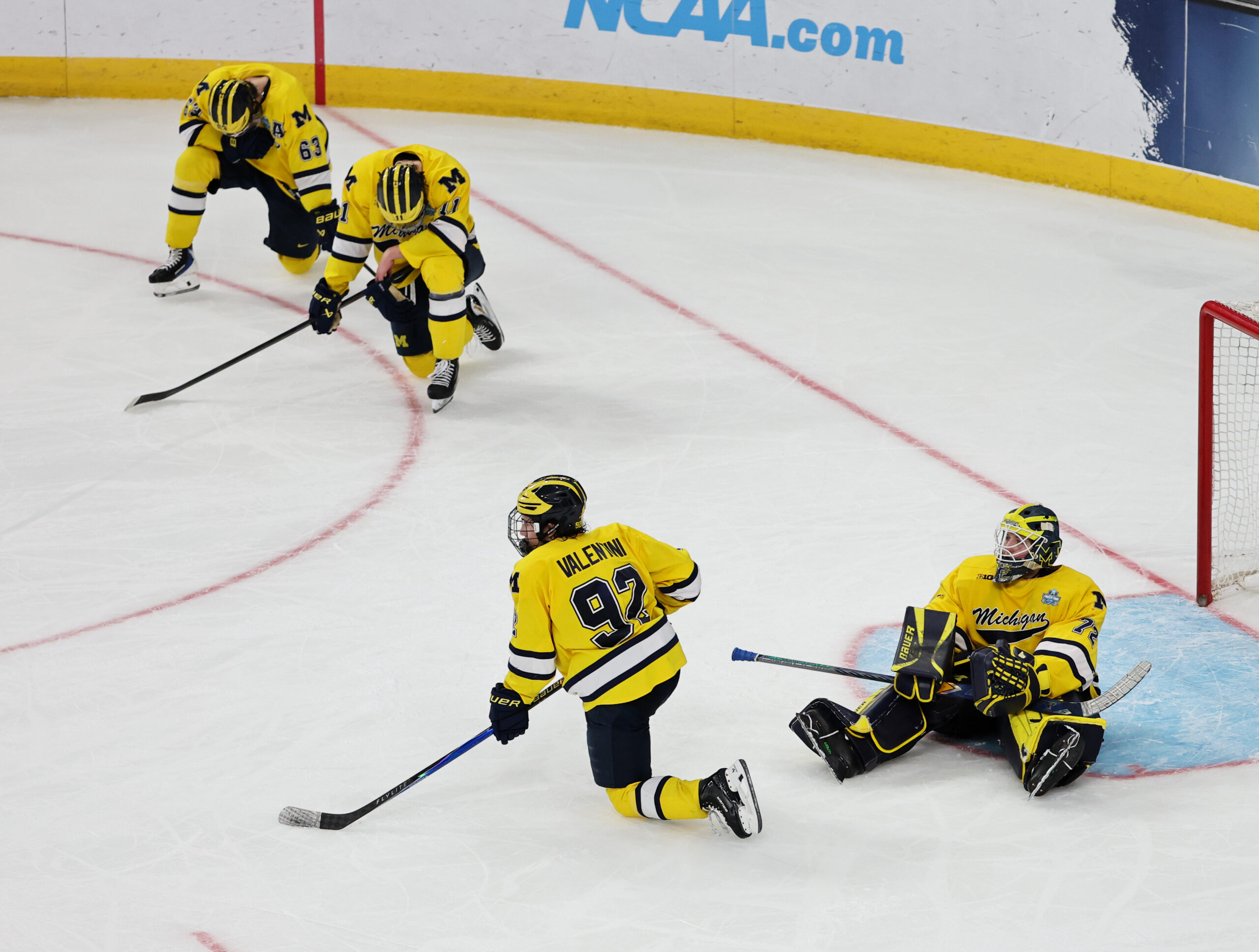
Adam Valentini understood exactly what he was signing up for when he made the decision to jump from the USHL’s Chicago Steel straight to Michigan in the NCAA as a 17-year-old.
Leaving the USHL early to join Michigan as a true freshman in his NHL Draft year is not the safe route, especially for a 5-foot-10, undersized forward. The NCAA brings older players, stronger bodies, and a far more structured game, which often comes at the cost of offensive production, particularly early in the season.
And yet, Valentini did it anyway.
“I was confident in the choice I made,” Valentini said. “If I felt like I couldn’t, I wouldn’t have made it.”
That confidence is one of the first things Michigan head coach Brandon Naurato points to when describing him.
“He reminds me so much of Brad Marchand,” Naurato said. “He’s a dog out there and he’s got this self-belief. He does everything the hard way and doesn’t cut any corners.”
The adjustment was immediate. Valentini quickly noticed the jump in pace, size, and structure compared to what he had seen before.
“Definitely just the size and the speed of the game,” he said. “And how teams are very structured. That was kind of a really big thing for me that I had to get adjusted to.”
The numbers reflect that early transition. In 40 games, Valentini finished with 11 goals and 16 assists for 27 points, production that does not fully capture his impact on a deep Michigan roster. He moved throughout the lineup, earned ice time in different situations, and focused on building a complete game rather than chasing points.
That was by design. Michigan did not need him to carry the offense right away. It needed him to learn.
“He was admitted to Michigan this past academic year, but we talked to him about joining the team this season instead of next year,” Naurato said. “He never looked back. He just kept on learning.”
Michigan Development Path Paying Off for Valentini
The learning curve turned into visible progress as the season went on.
Valentini spent much of the year observing and absorbing habits from Michigan’s veteran core, particularly players like TJ Hughes. The details added up, both on and off the ice.
“He followed TJ Hughes and the rest of the seniors around and picked up their habits on the ice and in the gym,” Naurato said. “And it made a big difference as the year went on.”
By the second half, Valentini looked more comfortable holding onto pucks, attacking space, and creating plays in the offensive zone. The confidence came gradually, but once it arrived, it stuck.
“I feel like I just got more confident as the games went on,” Valentini said. “I had some success and to see some good success really helped me just play my game.”
The growth was not only mental. It was physical.
“He’s really improved his motor and playing with pace in games,” Naurato said. “He’s always had a good set of skills, but his conditioning improved, allowing him to drive his engine for longer periods.”
That motor defines Valentini’s identity as a player. He describes himself as “a 200-foot player that plays every inch of the ice really hard,” and that approach shows up in his willingness to compete regardless of size.
But at 5’9 and 190lbs, the height concerns regarding Valentini will always be there, and are one of the main reasons NHL Central Scouting ranked him the 86th-best North American skater for the 2026 NHL Draft.
Many still believe Valentini will end up in the 2nd or 3rd round once the draft rolls along in Buffalo in late June, because, despite the size concerns, he plays much bigger than what his biometrics may suggest.
“I don’t care if you’re 6-foot-6, 6-foot-4,” he said. “I’ll go right into that corner and take the puck right off you. It honestly doesn’t matter. It’s heart and how much you want it.”
There is also a strong belief inside Michigan that his production could have looked very different in another situation.
“I believe he could have been a point-per-game player as a true freshman in the NCAA had he been playing on a less stacked team,” Naurato said. “He’s that good.”
Instead of chasing that opportunity elsewhere, Valentini gained something else. He played meaningful games on a team with championship expectations and experienced a deep run as a freshman, something few players in his draft class can match.
Adam Valentini’s NHL Draft Outlook and Breakout Potential
That experience now becomes his advantage.
Valentini will enter next season no longer trying to keep up but ready to contribute in a larger role. He already understands the pace, the structure, and the daily demands of the NCAA. That foundation could allow his offensive game to take a significant step forward.
Late in the season, there were already signs of what that could look like. Valentini found chemistry with Michael Hage, a player he has known since childhood.
“I’ve known him since I was six years old; we go way back,” said Valentini. “I used to play ton with him and his brother Alex, so it was great to link up this season.”
Valentini was able to showcase his full skill set when paired with Hage, especially late in the season. It helped the 18-year-old find another gear in his game when Michigan made a final push for the Big Ten championships and the Frozen Four.
“We feed off each other pretty well,” Valentini said. “We love playing with a lot of pace and he sees the ice so well.”
With Hage returning and key players like Will Horcoff expected to be part of the lineup, Michigan sees Valentini as a central piece moving forward.
“I expect him to be a top-end player with Michael Hage, Will Horcoff and the returnees next year,” Naurato said. “He has such good chemistry with Michael that the combination is almost natural.”
Valentini’s path will not look like everyone else’s in his draft class. The numbers may not immediately stand out next to players who stayed in junior and played bigger offensive roles. But history suggests that might not matter as much as it seems.
Every year, players get overlooked for the same reasons. Size. Situation. Production that does not quite match the talent. And every year, teams end up circling back to those misses.
Brad Marchand lasted until the third round. Lane Hutson fell into the second. Logan Stankoven slipped despite a dominant junior resume. All of them carried questions that look irrelevant in hindsight.
Valentini fits that mold.
He chose the harder path, played against older competition, and focused on building a complete game instead of chasing numbers. Inside Michigan, there is little doubt about what that could turn into.
“I wouldn’t take anything back,” Valentini said. “I did everything for a reason and I’m very happy with the decisions I’ve made.”
By next season, he will not be the undersized freshman adjusting to the NCAA. He will be the player driving play in it.
And if that trajectory continues, there is a very real chance that a few years from now, teams will be looking back at this draft class and wondering how they let Adam Valentini slip past them.